When mortal arrogance provokes the gods
In the complex ethical code of the ancient Greek world, there was no offense more serious than hybrisOften translated as 'pride' or 'arrogance,' hubris was actually something deeper and more dangerous: it was the deliberate act of crossing the boundarylimen) tra l’umano e il divino, ignorando la propria natura mortale e sfidando l’ordine cosmico stabilito dagli dei. Il Mito di Aracne ne è uno dei più celebri.
While many heroes succumb to hubris through brute force or political ambition Aracne she embodies the most subtle and modern form of this sin: the arrogance of intellect and the claim of art to be the ultimate judge
The Loom of Contention: The Arachne Myth
Arachne, a maiden of Lydia, possesses neither kingdoms nor armies. Her power lies in her fingers, capable of spinning webs so light they seem made of air, and colors so vivid they appear to be nature itself. Her hubris does not spring from a lack of talent, but from the refusal to acknowledge its origin. When she claims that her skill owes nothing to Athena, the goddess of crafts, Arachne breaks the pact of humility that binds the mortal creator to their divine muse.
The Challenge: Art as an Act of Accusation
Questa parte del tuo testo è incredibilmente moderna; tratti Aracne quasi come una "reporter" ante litteram che usa l'arte per smascherare il potere. Ecco la traduzione, mantenendo i termini forti come "opera di regime" e "contro-informazione": "The most disruptive aspect of the myth of Arachne lies in the content of the challenge. Athena, in her tapestry, weaves order: the victory of the gods, hierarchy, and the punishment of those who dared to defy them. It is a work of propaganda, a celebration of power. Arachne, instead, uses her loom to perform an act of counter-information. She weaves the The Betrayals of the Olympians (caelestia criminadepicting the acts of violence and the disguises with which Zeus and the other Olympians deceived mortals. Her hubris is twofold
- TECHNICAL: She usurps the deity’s place in the primacy of excellence
- Moral: She uses art to denounce the immorality of her own judges
Nemesis: From Word to Instinct
The deity, first 'annoyed' and then furious, does not strike Arachne because her work is ugly, but precisely because it is perfect. Human perfection is intolerable to Olympus because it erases the distance between the temple and the home. The punishment—the nemesis—is a masterpiece of cruel irony. Athena transforms Arachne into a spider. It is a metamorphosis that does not negate her skill, but strips it of intellect and voice. The spider will continue to weave for eternity, but it will no longer be able to tell stories, no longer denounce the crimes of the powerful, no longer boast. Its art becomes pure biological instinct, a bodily function devoid of critical spirit.
The Transfiguration: The Myth’s Inverted Mirror
The destiny of Arachne reveals how hybris is the engine of the major myth of trasfigurationIn Greek cosmogony, the mutation of the body is the only possible response to a soul that has occupied too much space: the flesh bends to contain the exuberance of the spirit or to punish its daring.
Here, a dramatic paradox is fulfilled, which is the exact inverse of what Arachne had depicted in her infamous tapestry. If the maiden had denounced the transfigurations of the gods—who changed their forms into a bull, a swan, or a golden shower in order to deceive mortals and satisfy their own desires—her transformation into a spider is a transfiguration endured, an act of force that degrades her. While the gods transfigure themselves to descend among men and dominate them, the human guilty of. hybris is transfigured to be expelled from the human community and reduced to a silent, submissive element of nature. Metamorphosis thus becomes the divinity’s definitive seal upon matter: the human who sought to become God ends up becoming less than man.
Conclusion: Arachne’s Admonition
The myth of Arachne reminds us that for the ancient Greeks, creativity was a gift to be managed with reverential awe. Arachne’s hubris marks the boundary between the artist who honors beauty and the artist who uses beauty as a weapon against the established order. Even today, the figure of Arachne suspended from her thread speaks to us of the risk inherent in every creative act: the illusion that our work can make us immortal or invulnerable, forgetting that, no matter how perfect the web we weave, there is always a divine hand—or the force of destiny—ready to tear the tapestry apart.
The Eye of the Artist: Arachne between Canvas and Ink
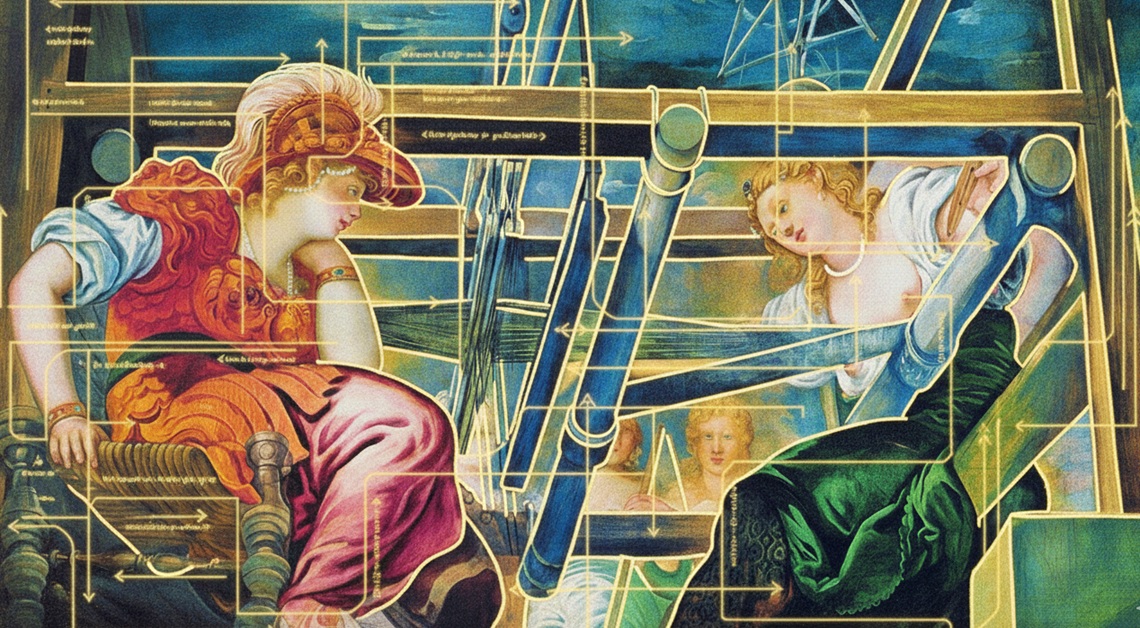
"The myth of Arachne has offered figurative artists an extraordinary challenge: how to represent not only the duel, but the very beauty of those 'invisible' tapestries described by Ovid. In art, Arachne’s iconography is never static; it evolves following the three key moments of the myth: the. challange the artistic creation) the punishment the intervention of power) and the metamorphosis "(the loss of the human). From the conceptual complexity of Velázquez to the dramatic intensity of Rubens, art has transformed Arachne’s loom into a stage where the clash between individual genius and divine authority is played out.
Iconographic Evolution of the Myth
| Period and Style | Masterpiece and Artist | Moment of the Myth | Narrativ Core |
| Siglo de Oro | Le Filatrici (Velázquez) | The Intelletual Challange | Metalanguage: Arachne’s tapestry cites Titian, celebrating art that surpasses reality. By weaving a masterpiece that mirrors a real painting, the myth transcends its own narrative: it is no longer just a story about a weaver, but a manifesto on the power of mimesis and the artist’s ability to rival nature itself." |
| Baroque | Atena e Aracne (Rubens) | The Divine Violence | The disproportion of force: the exact moment in which the goddess strikes the defenseless maiden." |
| Neapolitan Baroque | La punizione di Aracne (L. Giordano) | the Censorship | The destruction of the tapestry: power tearing away the uncomfortable truth told by art |
| Illustration | Purgatorio (G. Doré) | The metamorphosis | The horror of the transformation: the human body succumbing to the beastly nature of the spider." |
| Symbolism | Aracne (Varie interpretazioni) | the Melancholy | "The solitary artist: the web becomes a precious lace, a symbol of waiting and dedication |
The Loom as Metaphor
The element that unites all these representations is the transition of the web from an instrument of defiance and an object of condemnationWhile in Baroque works the tapestry is the heart of the competition, in nineteenth-century and Symbolist illustrations the web becomes Arachne’s only remaining legacy: a perfect but fragile weave, much like the human condition in the face of destiny
Leave a Reply