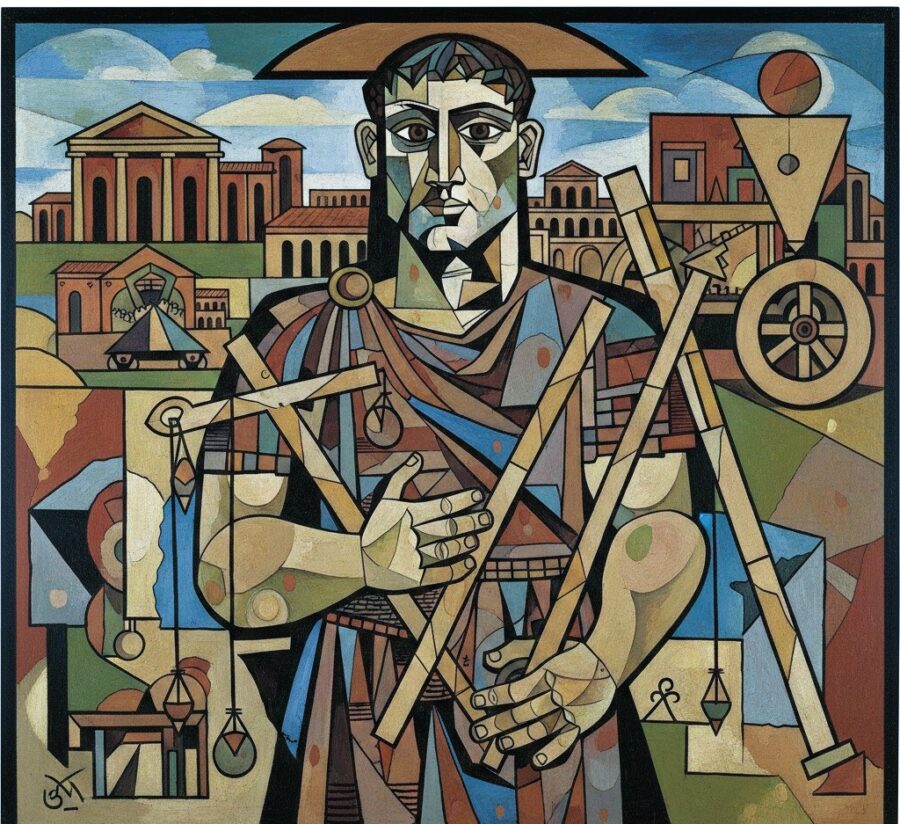
For the Romans, measuring the world was not merely a matter of commerce; today, ancient Roman measurements reveal incredible secrets. It is not just about engineering; it is a supreme declaration of authority and cosmic harmony. CONTROL AND POWEREvery road, straight as a blade, and every perfectly squared city that we still admire today is the result of a standardized measurement system that has defied millennia.
In questo viaggio tra storia e curiosità, scopriremo come le unità di misura antiche abbiano dato il nome alle nostre città e quali tesori della “scienza del territorio” sono custoditi nei musei.
Il corpo umano come righello: Pes e Passus da dove nascono le misure
"The Roman system was fascinating because it began with the human being. The fundamental unit was the Pes (the foot), but the entire scanning of space was based on movement: Ancient Roman measurements are anthropocentric."
- The Gradus: the single step
- the Passus the double step aprox 1,48 meters
- The Mile(Mila passuum) one thousand double steps, the foundation of the Imperial road system.
Even today, when we say a place is 'just a few steps away,' we are unconsciously using the system of our ancestors
I professionisti del territorio: I Gromatici
Behind the pinpoint precision of the Consular roads were the Gromatici (or Agrimensores), the surveyors of antiquity. To transform forests and marshes into orderly cities, they used ingenious tools. Gromatici (o Agrimensores), i geometri dell’antichità. Per trasformare foreste e paludi in città ordinate, usavano strumenti ingegnosi:
- the Groma A cross-shaped instrument with plumb lines used to plot perfect right angles (the Cardo and the Decumanus). This tool was the heart of the construction site, guaranteeing the precision of ancient Roman measurements even on the most challenging terrains. misure antiche romane anche su terreni difficili.
- The Decempeda A 10-foot (3 meters) rigid rod used for rapid measurements."
- The Odometer An incredible gear mechanism that dropped a stone into a container for every mile traveled. A true ancient ancestor of our modern odometer!"
Città che “danno i numeri”: La toponomastica delle pietre miliari
Have you ever noticed how many Italian city names hide a number? Along the great routes like the Appian Way or the Via Emilia, settlements often emerged at the. Mile StoneThe most important measure in roman history
| Distance | Modern Town | Latin Origin |
| 4 Miles | Quarto Oggiaro (MI) | Ad quartum lapidem (alla 4° pietra) |
| 5 Miles | Quinto Romano (MI) | Ad quintum |
| 6 Miles | Sesto San Giovanni (MI) | Ad sextum |
| 7 Miles | Settimo Torinese (TO) | Ad septimum |
| 9 Miles | Pontenure (PC) / Novi Ligure | Ad nonum |
| 10 Miles | Diecimo (LU) | Ad decimum |
This entire system centered on the Milliarium Aureum (the Golden Milestone) in the Roman Forum: a bronze column commissioned by Augustus, inscribed with the distances to all the major cities. This is why, quite literally, all roads lead to Rome..
Stabiae e la misura: I tesori del Museo “Libero D’Orsi”
If you want to experience this precision firsthand, the Museo Archeologico di Stabia “Libero D’Orsi” (inside the splendid Royal Palace of Quisisana in Castellammare) offers unique evidence of the bond between measurement, law, and art."
The Boundary Stone and Centuriation
In the museum, you can admire artifacts related to centurazione dell’Ager StabianusA great example are the Cippi they were stone blocks that the Gromatici drove into the ground to mark the intersection between plots of land
- Why they are so important? They were true legal documents. Engraved upon them were the coordinates ( b.e Kardo Maximus) to resolve boundary disputes between the landowners of Stabiae, Pompeii, and Nuceria.
Il Doriforo: La misura della bellezza
The concept of 'measurement' in Stabiae didn't just concern the fields, but art as well. The museum houses references to the famous Canon-Rule of Policlet. La copia del Doriforo ritrovata a Villa Arianna mostra come i Romani applicassero la matematica (usando il digitus, il dito, come unità base) per creare le proporzioni perfette del corpo umano. Oggi questa splendida statua non è in Italia ma negli Stati Uniti esposto al Minneapolis Institute of Art (MIA) nel Minnesota, ma è al centro di una lunga disputa legale per la sua restituzione all’Italia. Il volto più emblematico dell’atleta perfetto lo troviamo in un altro capolavoro dell’antichità del quale possiamo godere in assoluto al Mann, l’Erma del Doriforo di Villa dei Papiri di Ercolano.
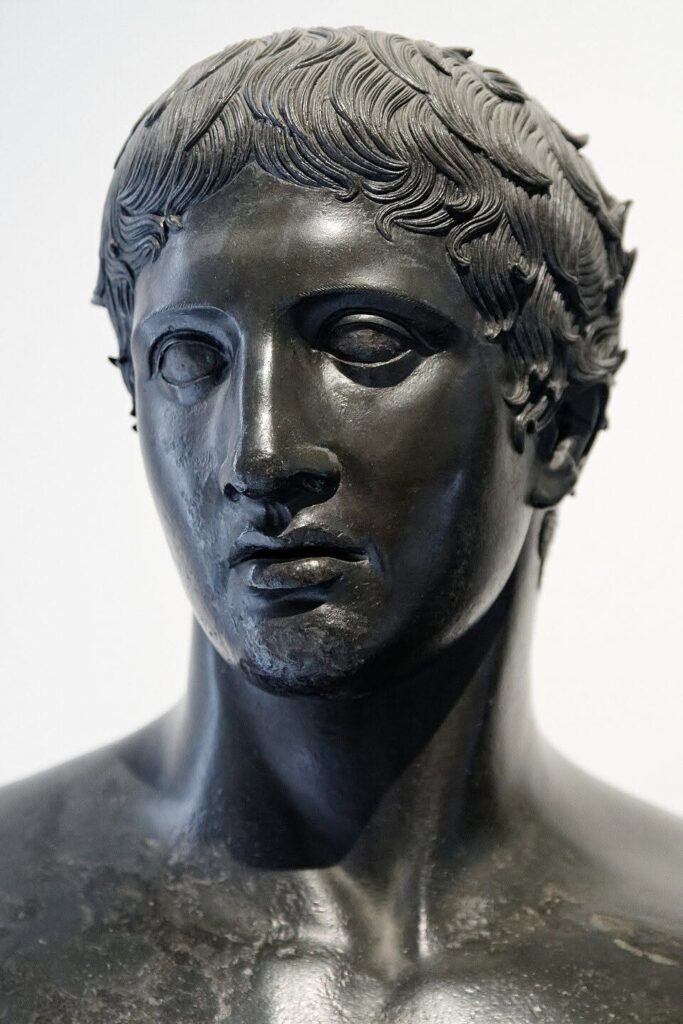
L’erma del Doriforo rappresenta uno dei punti più alti della scultura bronzea romana d’età augustea, non soltanto per la sua straordinaria fattura tecnica, ma per il suo immenso valore storico e concettuale. Rinvenuta a metà del XVIII secolo durante gli scavi condotti per cunicoli sotterranei nella maestosa Villa dei Papiri di Ercolano, l’opera fu sepolta dall’eruzione del Vesuvio del 79 d.C., conservandosi in un perfetto stato di conservazione.
Dal punto di vista tipologico, l’opera si presenta come un’erma, ovvero un pilastro quadrangolare sormontato da una testa scolpita, una forma espositiva particolarmente cara al collezionismo dell’aristocrazia romana. La testa riproduce con millimetrica precisione il volto del celebre Doriforo di Policleto, il capolavoro in bronzo del V secolo a.C. che codificò per sempre il canone delle proporzioni e dell’equilibrio dell’arte classica greca.
Trasformando una statua a figura intera in un busto su pilastro, l’autore romano non si limitò a una semplice copia, ma rielaborò il modello per adattarlo al contesto filosofico e decorativo della villa.
Un elemento di eccezionale rilevanza è la firma incisa in lingua greca sul petto della scultura: Apollonios, figlio di Archias, ateniese. Questa iscrizione rende l’opera una delle rarissime sculture romane di cui conosciamo con certezza il nome dell’autore. Apollonio, maestro ateniese attivo nel I secolo a.C.
Local Curiosity: the Cursus Publicus
Stabiae was not just a place of noble villas, but a fundamental crossroads of the Cursus Publicus .of the Roman logistical and commercial network. Situated between the sea and the fertile hinterland, it served as a vital link where the precision of land measurement met the flow of Mediterranean trade.
I hope that this jouney along the road fascinated you. misure antiche romane vi abbia affascinatoAntiquity lives among us, and decoding it is a true pleasure
MY SUGGESTION: "The next time you pass through a city named 'Settimo' or 'Quarto,' close your eyes: you are walking exactly along the measurement traced by a Roman surveyor two thousand years ago
Leave a Reply